JTC Leasehold Industrial: Planning for 60-Year/30-Year/20-Year Tenure Outcomes
Leasehold industrial property in Singapore is often discussed as if the tenure is a detail you only look at on the last page of a sale brochure. In practice, tenure quietly shapes almost everything that comes after your purchase: what kind of business you can run, how you plan your fit-out and renewal cycles, what exit options you will realistically have, and how your financing team will frame the asset.
This matters even more for JTC leasehold industrial units, because common tenure outcomes you will see in listings are 60-year, 30-year, and 20-year lease terms depending on the estate and product. Once you start planning backwards from those outcomes, decisions that looked “commercially flexible” at signing become much more precise at year 5, year 10, and year 15.
Below is a practical way to think about those tenure outcomes, tied to the planning realities behind B1 industrial zoning and the use controls that come with it.
The tenure question you should ask first
When buyers compare industrial properties, they often focus on “today’s cashflow” and “how it looks on paper.” Tenure changes the rules of the game because your economic life is not the same as the building’s marketing age.
With 60-year, 30-year, and 20-year terms, the planning rhythm changes:
- With longer leases, you can treat the property as a longer-run operating base, and you have more room to align fit-out amortisation with your business timeline.
- With shorter leases, you will naturally compress the horizon for upgrades, renegotiations, and exit planning. Any decision that locks you into a specific configuration needs earlier scrutiny.
The key is not to panic about shorter tenure. It is to acknowledge that you are buying a package of rights under JTC lease structure, and your “operating plan” must survive the tenure calendar.
B1 industrial zoning: what it enables, what it restricts
For buyers evaluating B1 industrial space, it helps to understand B1 as a planning intent, not Click here merely a label on a map. B1 is intended mainly for clean industry, light industry, warehouses, public utilities and telecom uses. Uses that would need a nuisance buffer of more than 50m are generally not allowed. Some general industrial uses may be considered case by case if buffer requirements are met.
That “clean and light” planning intent becomes a practical constraint for your tenant profile and your own business plan. It also affects how a future buyer might view the unit, because industrial resale liquidity can be sensitive to approved use and building characteristics.
There is also a use-quantum rule that tends to matter in real operations. At least 60% of the floor area, or GFA, in a B1 development or strata unit must be used for industrial purposes. The remaining area is limited to ancillary or supporting uses and approved secondary uses.
So, if you are thinking of buying industrial property Singapore for a business that includes offices, showrooms, training space, or other non-industrial functions, you cannot treat that part of the plan as purely “soft.” Under B1, the industrial component must remain dominant in floor area terms.
In the context of strata industrial units Singapore, this use-quantum logic can be the difference between a unit that works for your operations today, and a unit that becomes harder to lease or harder to sell if your business changes.
B1 versus B2: the planning consequence for “what you can do”
B1 and B2 are not just different bins for marketing. They point to different tolerance levels for industrial activity. B2 is the heavier-industrial category. In JTC listings for B2 units, the unit specs often reflect heavier use potential, such as higher floor loading and different height specifications than B1 flatted factories.
Even without getting lost in engineering detail, you should treat the B1 versus B2 choice as a way of matching your trade and future growth path to what the site is designed to support. If your processes are closer to “light manufacturing” and clean uses, B1 generally aligns. If your operations lean towards heavier industrial activity that requires different physical allowances, B2 is the more coherent starting point.
This also affects exit planning. A B1 industrial property can feel attractive to a broad set of “light” trades. A B2 asset, while potentially appealing to heavier users, can be narrower depending on how specific the use needs are. That is why a tenure plan should not be separate from a zoning plan.
Why tenure planning and approved use planning are linked
Lease tenure and approved use controls interact in a way that many first-time buyers underestimate.
You might be tempted to say, “If the business works for me now, I’m fine.” But your future buyer or tenant will ask different questions:
- Can the unit be used for the intended trade under the B1 constraints?
- Does the industrial use still take up the required share of floor area, at least 60% in B1 strata or B1 developments?
- Is the unit’s physical configuration, such as loading access and goods movement, aligned to the operation?
The context of Singapore industrial property investment is that resale and leasing are trade-specific. Official use controls and lease structures shape what is viable, and viability shapes liquidity.
So, if you buy a B1 industrial unit with a plan that sits near the edge of what is permitted, tenure becomes a multiplier of risk. Over a shorter lease, you have fewer years to adjust if regulators, landlords, or tenants challenge your operating arrangement.
60-year, 30-year, 20-year: how the economics change in real terms
Let’s treat the tenure lengths as planning horizons, not just a number on a lease term.
60-year tenure outcome: building a longer operating runway
A 60-year JTC leasehold industrial outcome gives you more time to plan for the “middle years,” not just the launch. If you are ramping up industrial units Singapore type operations, you often need a sensible order of priorities: start with a workable layout, refine after demand stabilises, and then upgrade when volumes justify it.
In a 60-year window, you can be more deliberate about your ramp-up period and still have a meaningful runway to correct mistakes. Your refinancing options can also be more flexible because the lender’s view of risk is tied to time, and longer remaining tenure typically reduces some forms of lender concern compared to shorter terms, though the exact underwriting depends on the lender’s assessment.
30-year tenure outcome: where you start matching fit-out cycles to lease reality
A 30-year lease changes how you should think about “decisions you cannot easily unwind.” Fit-out is expensive, and moving costs are not just financial, they are operational. For many trades, you do not want to rebuild your workflow every time you sign a lease renewal.
At this tenure length, it becomes more important to align:
- your expected business lifecycle,
- your likely tenant profile (if you plan to industrial property rental yield Singapore by letting the space),
- and your exit planning timing.
If you buy strata industrial units Singapore, the practical reality is that your ability to re-tenant may hinge on whether your unit can support the next tenant’s approved use and logistics needs. JTC materials emphasise that technical checks include floor loading, ceiling height, goods-lift access, loading-bay provision, and whether the trade matches the approved use. Those checks are not “paper requirements” you can ignore.
20-year tenure outcome: treat exit planning as part of the purchase, not a later task
A 20-year outcome compresses everything. You will not have the luxury of treating the property as a passive long-term asset for decades. You need an exit narrative that can hold up under realistic market behaviour, especially because resale liquidity in industrial can be trade-specific and sensitive to approved use, strata size, and building specs.
This is where a disciplined buyer separates “can I operate here” from “can I exit here.” In B1, that includes confirming your industrial use quantum will stay compliant as your business evolves, and that your operational needs fit within the zoning intent, including the clean and light nature and buffer constraints that generally not allow nuisance buffer over 50m.
In practice, a 20-year plan often works best when the business model is stable and the trade fits the unit specifications strongly from day one.
City-fringe locations: why they matter more for logistics than for marketing
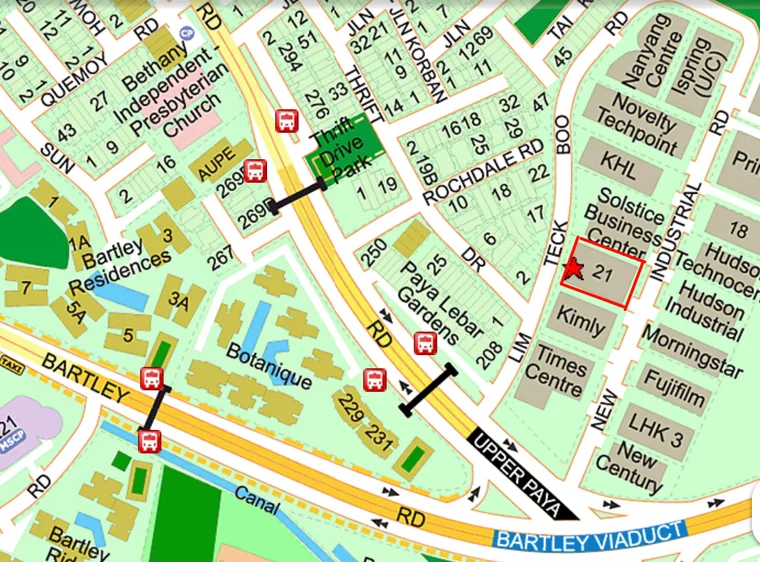
City-fringe industrial precincts such as Tai Seng, Paya Lebar, Ubi, Kallang and MacPherson are often favoured for e-commerce, light manufacturing, R&D and urban logistics because they are closer to workforce catchments and transport links. This positioning makes sense particularly for B1 users, since B1 is geared towards clean industry and warehouses, with many tenants in those trades.
If you are considering Tai Seng industrial property or Paya Lebar industrial property, or you are simply comparing “city-fringe” versus “outer estates,” the practical takeaway is that logistics efficiency becomes more valuable when you are trying to keep your operating costs stable under a limited tenure window.
A tenure-limited asset does not necessarily mean you will suffer. It means you should choose a location and unit design that makes operations smoother, because smoother operations are easier to explain to future tenants and business buyers.
Ramp-up and access: flatted factories versus ramp-up factories
Even within similar zoning, the way a unit is accessed can change your day-to-day workflow and your ability to scale without reworking the premises.
JTC describes ramp-up factories as providing direct vehicular access to units for loading and unloading. Flatted factories are generally accessed via common corridors, lifts and loading bays. A unit’s layout affects logistics efficiency, truck access, and fit-out flexibility.
When planning tenure outcomes, access design becomes a form of risk management. If your business depends on frequent loading cycles, a ramp-up arrangement may reduce operational friction. If your volumes are more modest or your goods movement can work through loading bays and lifts, flatted factories can still be practical.
This is not a universal “better or worse.” It is a matching exercise to your workflow, and workflow alignment matters because B1 use-quantum compliance expects industrial usage to remain a significant share of floor area. If your operational model does not fit the logistics reality, your effective industrial usage can suffer over time.
Financing and the reality of how lenders think about industrial assets
Industrial property loan Singapore decisions are rarely handled exactly like residential lending. Market practice and regulatory materials indicate that property investment financing generally depends on lender assessment, and non-residential loans often sit under commercial terms rather than residential housing-loan rules.
So even if two buyers share similar bank relationships, the details can still diverge because lenders may evaluate:
- remaining lease tenure,
- unit specs and suitability for the trade,
- and expected rental stability if the unit is being held for industrial property investment Singapore.
If you are financing a 20-year outcome, expect lenders to focus more on freehold B1 industrial Singapore how the unit can generate credible rental or operational value over a shorter remaining timeline. If you are financing a 60-year outcome, the lender’s confidence may improve simply because there is more time for the asset to perform.
The practical advice is to treat your lender conversation as part of your acquisition planning, not an afterthought once you have already decided on the unit.
Buying under a company name: what changes and what does not
It is common for industrial assets to be held under a company name, especially when the property is used for business or held for investment. In stamp duty context, it is important not to confuse the residential-specific ABSD regime with industrial property rules.
Verified guidance states that industrial property is not subject to Additional Buyer’s Stamp Duty. ABSD is associated with residential property acquisitions. For industrial transactions, normal BSD rules apply, and on disposal, Seller’s Stamp Duty may apply where applicable.
Seller’s Stamp Duty for industrial property is based on holding period, with rates stated as 15% if sold within 1 year, 10% within 1 to 2 years, 5% within 2 to 3 years, and none after 3 years.
That SSD schedule is one of the few hard levers you can use to plan exit timing and reduce unnecessary cost if you expect a quick turnaround. It also ties back to tenure planning. If you expect to sell after a short holding period, SSD can materially change your total return calculation.
Taxes and purchase cost: GST can apply on new non-residential property
If you are buying a new non-residential property from a GST-registered seller or developer, GST is payable on the purchase. Verified guidance states that buyers of non-residential properties must pay GST if the seller is GST-registered.
This becomes relevant when you compare “new launch industrial property Singapore” opportunities versus resale units. The GST component can impact your cashflow planning and your effective yield on industrial property investment Singapore.
Rental yield thinking without the fantasy numbers
Many buyers ask about industrial property rental yield Singapore as if there is a single typical rate for JTC leasehold industrial. In reality, the “yield” you can achieve depends on factors that are tightly connected to use-quantum and unit specs.
In B1, at least 60% of floor area must be used for industrial purposes, with the remaining area limited to ancillary or supporting uses and approved secondary uses. That requirement can shape what tenant mixes work and what tenant agreements remain compliant.
Also, rental stability for industrial tends to be trade-specific and sensitive to approved use, lease tenure, strata size, and building specs. So when you build a rent model, you should stress test for tenant suitability, not just for market optimism.
A realistic buying framework for JTC leasehold industrial outcomes
Here is the workflow I would use to plan for 60-year, 30-year, and 20-year outcomes, especially when the unit is B1 industrial property Singapore or a strata industrial unit where the industrial use quantum matters.
First, align the trade with the zoning intent. B1 is meant for clean industry and light industry, with nuisance buffer limits generally not allowing more than 50m buffer needs. Second, check operational viability against the use-quantum rule, where at least 60% of floor area/GFA must be used for industrial purposes in a B1 development or strata unit. Third, verify technical fit using the kinds of checks JTC highlights, including floor loading, ceiling height, goods-lift access, loading-bay provision, and trade match to approved use.
Only after you have those three pieces aligned should you “overlay” your tenure horizon. A 60-year lease can absorb more adjustment over time. A 20-year lease demands tighter alignment from the start and earlier thinking about leasing and exit.
If you are deciding between a B1 and a B2 industrial zoning option, treat it as matching the heavier industrial feasibility to the property’s tolerance. B2 often implies heavier-industrial use potential, and JTC listings may reflect different specs such as higher floor loading and different height allowances than B1.
If you are selecting between ramp-up and flatted factories, treat access as part of your operating plan, not an aesthetic difference. Direct vehicular access to ramp-up units can matter for loading/unloading cadence, while flatted layouts that rely on common corridors, lifts, and loading bays can still work, but they change your workflow and ramp-up logistics.
Finally, integrate your financing conversation. Industrial property loan terms depend on lender assessment, and remaining tenure influences risk. Your underwriting should match the tenure outcome you are buying.
One decision that often surprises buyers: “approved use” can be a long-term constraint
Industrial buyers sometimes think of “approved use” as something you confirm once, then forget. But in B1, the 60% industrial use quantum and the nuisance buffer principles are tied to how the site can operate. Over time, businesses evolve, and the most common operational drift is towards more ancillary space, more non-industrial activities, or a shift in product type.
If your business plan requires more changeable space configurations, a shorter lease tenure increases your risk exposure because you have less time to reposition the asset or recover from an operational mismatch.
So it is not that B1 industrial property Singapore is “hard.” It is that B1 is structured to support clean and light operations, and those constraints shape long-term flexibility.
Where keywords and real choices meet your daily planning
When buyers ask about “buy industrial property Singapore,” they often bundle together very different categories: city-fringe units like Tai Seng industrial property or Paya Lebar industrial property, new launch industrial property Singapore, strata industrial units Singapore, and sometimes even light industrial space for sale Singapore.
The common thread is that your best choice depends on whether the unit’s intended use fits your operational reality today and how sensitive your business model is to tenure and approved use constraints.
If your trade is naturally aligned to B1 clean and light use, and your operations can comfortably keep industrial usage at the required 60% share, then JTC leasehold industrial can be a workable long-term asset. If your growth path pushes towards activities that behave more like heavier industrial use, you should take the B1 versus B2 question seriously rather than hoping it “works out later.”
And regardless of zoning, tenure is the timeline that forces discipline. A 60-year plan can be forgiving. A 20-year plan should be conservative and explicit about fit, logistics, tenant suitability, and exit cost, including Seller’s Stamp Duty if you end up selling within the holding period windows.
Practical trade-offs to watch before you commit
The decision you make on purchase day is a bundle of trade-offs. Based on the planning rules and unit realities, here are the main tensions that show up repeatedly in real transactions.
A B1 unit might be easier to lease to trades that fit clean/light industry, but your industrial use quantum and buffer principles tighten how you can allocate space. A B2 unit might support heavier operational use potential, but the market for tenants that fit those use needs can be narrower. A ramp-up unit can reduce logistics friction for loading and unloading, but it can come with different fit-out constraints compared with flatted units that rely on common corridors and lifts. A 60-year tenure can make financing and planning calmer, while a 20-year tenure pushes you to treat exit planning as a requirement, not a hope.
When you plan for JTC leasehold industrial, the most durable approach is to start with use and logistics, then match tenure, then bring in financing and taxes such as GST for GST-registered new non-residential acquisitions, and Seller’s Stamp Duty if you might dispose within the first three years.
If you do that in the right order, the lease term stops being an anxious guess and becomes a clear part of your investment thesis.